MESALODE EM415Pro Automotive Wire Tracer & Short/Open Circuit Finder | 6–42V DC
MESALODE EM415Pro Automotive Wire Tracer & Short/Open Circuit Finder | 6–42V DC
BUNDLE & SAVE
Couldn't load pickup availability
Safe & Secure Checkout
256-bit SSL encryption
protects every order.
30-Day Guarantee
Love it or get a full refund.
No hassle.

MESALODE EM415Pro Automotive Wire Tracer & Short/Open Circuit Finder | 6–42V DC
MESALODE / EM415PRO
THE FUSE BLEW.
AGAIN.
You replaced the fuse. Maybe even a part. But the electrical fault is still there. When the wire disappears into a harness, knowing where to look is half the battle.
VIEW PRODUCT & BUYING OPTIONS ↑For supported 6–42V DC automotive circuits. Use according to the vehicle and tool manuals.
THE PROBLEM
THE EASY FIX IS OFTEN THE LAST STEP.
A dead light. A circuit that works one day and fails the next. A fuse that keeps blowing. The part you can see isn't always where the trouble started.
- The suspect wire vanishes behind trim.
- The harness branches into dozens of wires.
- Swapping parts still hasn't found the cause.
Don't start with another guess. Start with the circuit.


WIRE TRACING / TONE MODE
GIVE THE WIRE A SIGNAL TO FOLLOW.
Connect the transmitter to the appropriate circuit. Bring the receiver's probe near the target wiring and listen as you follow its path.
Signal changes provide clues, not an automatic fault diagnosis. Verify a suspected break with standard electrical tests.
SHORT CHECK / CONT MODE
A BLOWN FUSE IS A CLUE. NOT THE ANSWER.
Use the transmitter's CONT setting to check for a suspected short or unwanted continuity in an isolated circuit—before replacing another component on a hunch.
For CONT/short checks, disconnect circuit power and remove the loads first. Follow the EM415Pro instructions and the vehicle service manual.

HOW IT WORKS
A PROCESS YOU CAN FOLLOW.
Trace a target wire with a deliberate routine instead of opening every section of the harness at once.

Set up the transmitter on the appropriate target circuit using the specified test procedure.
Keep the receiver probe close to the wire. Adjust sensitivity as needed.
Investigate signal changes and confirm the suspected fault with additional testing.

MADE FOR REAL HARNESSES
WIRING RARELY SITS IN THE OPEN.
The flexible coiled-steel probe bends toward wiring tucked around brackets and crowded components, helping you position the sensor where a rigid tip would be awkward.
Get closer to the wire. Not closer to tearing the car apart.
Access still depends on the vehicle; some trim or component removal may be needed.
MANUAL SIGNAL CONTROL
WHEN THE SIGNAL CHANGES, YOU CAN ADJUST.
The receiver's sensitivity control lets you tune signal pickup while tracing. Turn it up for a weak signal—or down when a crowded harness makes the response harder to interpret.


RESPECT THE ORIGINAL WIRING
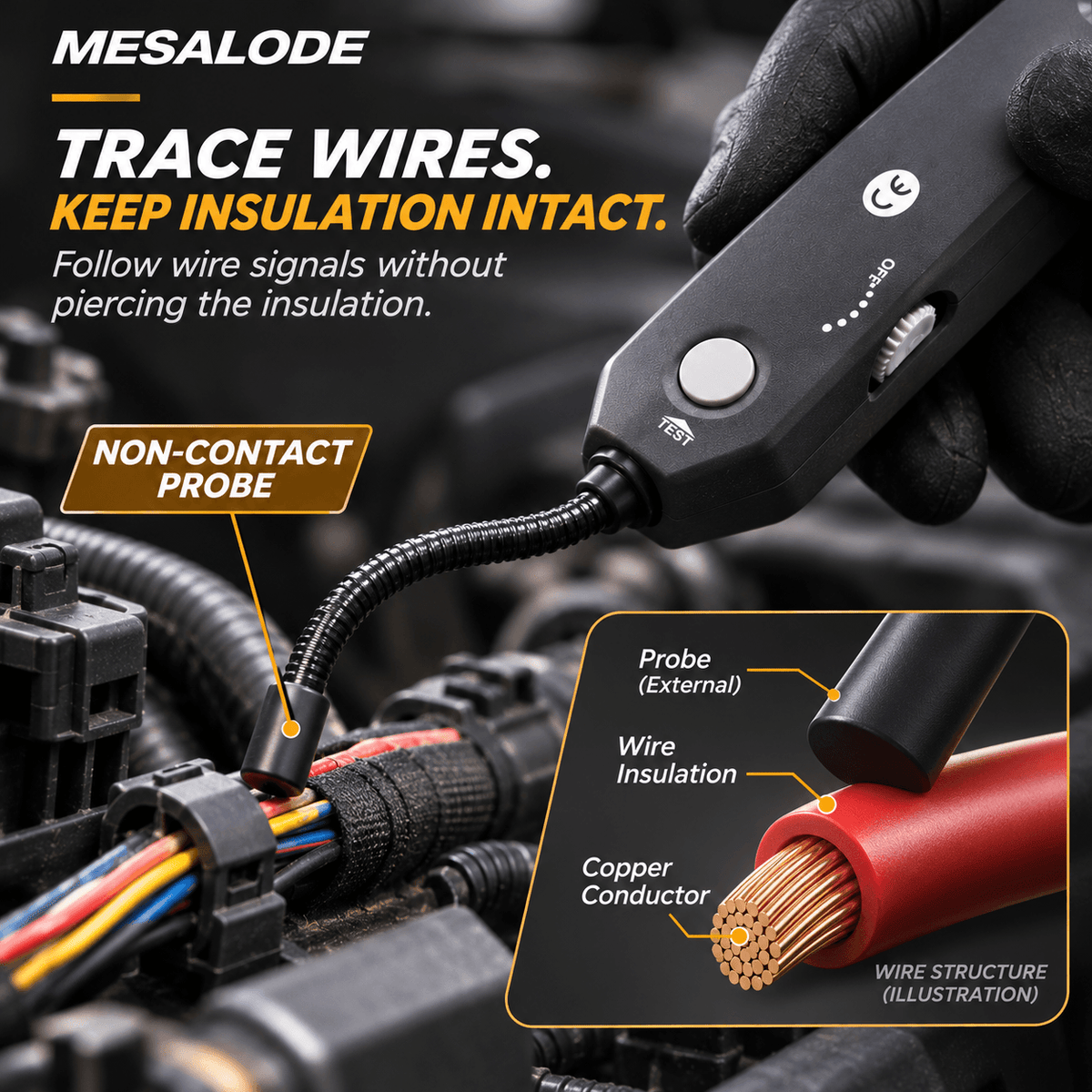
TRACE THE SIGNAL. LEAVE THE INSULATION INTACT.
When properly configured, the receiver can sense the tracing signal near an insulated wire. That means the receiving probe doesn't need to pierce the insulation just to follow a wire.
The receiver probe is non-piercing. The transmitter still needs a proper connection to the circuit at the prescribed test points.
REAL-WORLD TROUBLESHOOTING
FOR THE PROBLEMS THAT DON'T SHOW THEMSELVES.
A purposeful addition to the electrical troubleshooting workflow—not a replacement for a meter, wiring diagram, or sound diagnosis.
THE FUSE KEEPS BLOWING
Help narrow down wiring that deserves a closer short-circuit inspection.
A CIRCUIT GOES DEAD
Follow a target wire and investigate where the expected tracing signal changes.
THE HARNESS DISAPPEARS
Identify and trace wiring routed through crowded or partially hidden areas.
KNOW WHAT YOU'RE BUYING
TWO TOOLS. ONE PURPOSE.
A transmitter and receiver designed to work together for automotive wire tracing and short/open circuit troubleshooting.
Do not use on ignition-system circuits, AC circuits, high-voltage EV/hybrid systems or circuits above 42V DC. Follow the vehicle's service procedures and protect sensitive electronics before testing.
BEFORE YOU ORDER
STRAIGHT ANSWERS FOR REAL REPAIRS.
Will it show me the exact spot where a wire is broken?
It helps you follow a target wire and investigate a change or loss of tracing signal. That can narrow the area to inspect, but signal strength is affected by circuit layout, nearby wires and probe position. Confirm the suspected break with a multimeter and the vehicle wiring diagram.
Do I have to strip or pierce the wire insulation?
Not to follow the tracing signal with the receiver probe. The receiver senses the signal near insulated wiring. The transmitter still needs a proper electrical connection at an appropriate circuit test point.
Can I use it on a circuit that keeps blowing a fuse?
It can be part of a short-circuit diagnostic process. For CONT checks, first remove power and disconnect the loads as instructed. A repeatedly blown fuse can have multiple causes; do not keep replacing fuses without identifying the problem.
What if I hear a weak signal—or tones on nearby wires?
Check both 9V batteries and the transmitter connection. Bring the receiver tip closer to the target wire, hold it near a 90° angle when practical, and adjust sensitivity. Very dense harnesses, shielding and circuit configuration can make tracing harder.
Is this a replacement for my multimeter or scan tool?
No. The EM415Pro is a wire-tracing and short/open troubleshooting aid. Use a multimeter, wiring information and the vehicle service manual to confirm the actual electrical fault before repairing or replacing parts.
Will it work on hybrids, EV high-voltage wiring or household AC?
No. Do not connect it to high-voltage EV/hybrid circuits, household AC or vehicle ignition circuits. It is intended for compatible low-voltage automotive DC applications within the stated 6–42V range.
MESALODE / EM415PRO
STOP CHASING THE SYMPTOM.
START TRACING THE CIRCUIT.
When the wiring problem isn't obvious, take a more deliberate path to the answer. Review the EM415Pro kit and choose your purchase options above.
BACK TO PRODUCT & BUYING OPTIONS ↑ Check compatibility, package contents and store policies before purchasing.